
circularhealth.io Closed beta

Health Evidence Engine

A single result is an anecdote. A sequence is a story. We read the story, private by design.

The evidence engine for practitioners in chronic, complex care. CircularHealth unifies a patient's scattered data, breaks the silos between disciplines, and detects the meaningful patterns a single test misses, turning everyday health data into evidence without taking custody of identity.

Practitioner? Get in touch See how it works
A practitioner and patient in conversation in a bright practice office

Spend the time on exchange and solutions, not on reconstructing data.

01The evidence gap

Health data lives in silos. The body does not.

An endocrinologist sees glucose. A gastroenterologist sees the microbiome. A sleep specialist sees heart-rate variability. Chronic disease crosses every one of those boundaries — and no single clinician sees the whole.

Chronic conditions are now the dominant health burden worldwide, behind roughly three-quarters of all deaths — the rule, not the exception. Care stays siloed, judged against reference ranges instead of your own history, and triggered by symptoms with little regard for what's upstream or down. The data is fragmented, and so are the tools meant to make sense of it.

CircularHealth gives the patient and the practitioner one shared, longitudinal view.

Three downstream failures

Failure 01

“Normal but not okay.”

Chronic conditions don't announce themselves with one out-of-range value. They show up as markers that are each “normal” but drifting together — a direction snapshots never catch.

Failure 02

Great results, no proof.

Root-cause approaches report markedly higher remission rates than standard care. Without structured data, clinical intuition never becomes population-level evidence.

Failure 03

No safe place to think.

Every interaction carries identity, billing and compliance weight. A hypothesis has to justify itself inside a seven-minute appointment tied to a billing code.

02How it works

From scattered data to the right conversation

Spending time where it's needed: from practitioner to patient. As a practitioner, you don't want to go through scattered data sources. As a patient, you want to be empowered. Plus an informed patient is easier to explain things to.

01

Collection

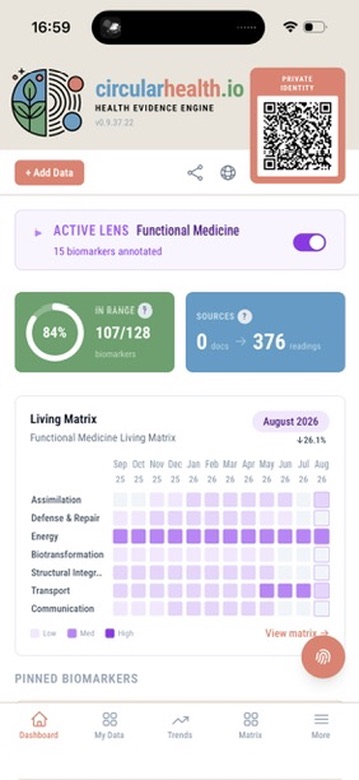
One anonymous timeline. All your health data — labs, wearables, questionnaires, notes — in a single, chronological view.

02

Intelligence

Trajectories, not snapshots. Each marker becomes a trend over time, and rule-based flags catch clinical patterns instead of just coloring values red or green.

03

Guidance

Personalized summaries tied to your actual patterns, filtered through your active lens, to prepare the right questions for the next appointment. Your patient arrives informed. You arrive prepared.

04

Sharing

Your patient shares their health record via a private link, on their terms — a single download, a 24-hour window, a scoped view that dissolves when its purpose is fulfilled.

CircularHealth App Dashboard

CircularHealth iOS dashboard — the timeline the four steps produce
Patient:

Feeling empowered. Being a partner, not patient.

Practitioner:

You don't lose control. You gain capacity.

03Spotlight

Spotlight: The Living Matrix, populated by live data

Seven biological systems rendered over time. Every reading is resolved to a stable observation identity and mapped, through the active lens, onto the system it belongs to. No hand-building, and no name attached to any of it.
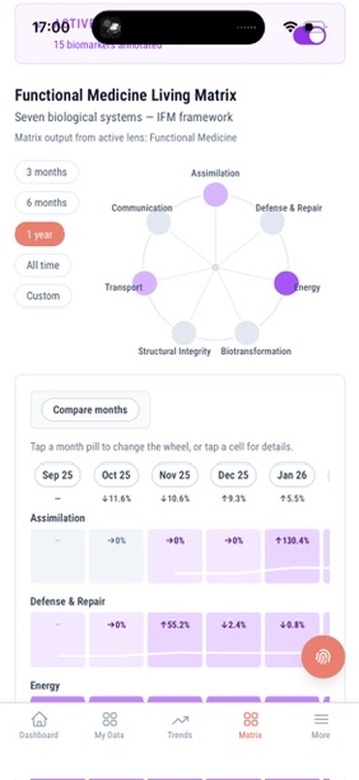
Systems × Time Seven biological systems as load over months. Watch gut load rise, then metabolism follow — the cross-system story a single test can’t tell.
Self-populating The wheel and heatmap fill themselves from the data you already order. No re-plotting the poster every visit — the work that killed the old Lifestyle Matrix.
Traceable Every cell traces to the exact readings and thresholds behind it. No black-box score.
Your framework A lens output, not a fixed chart. The same data reads through functional, conventional, or your own model.
Functional Medicine Living Matrix wheel and month-by-month comparison in the CircularHealth app
04Manifesto

Medicine was built for acute illness. Today it deals mostly with chronic disease.

Chronic conditions are now roughly three-quarters of deaths worldwide — the rule, not the exception. But population-averaged medicine was built for acute illness: most approved drugs help only 1 in 4 to 1 in 25 people. Slow, systemic disease needs the opposite — one patient's data over time, read across disciplines. Regulators in the EU and US are starting to accept exactly that: real-world and N-of-1 evidence. The medicine is shifting; the infrastructure to capture it doesn't exist yet.

Modern healthcare is impressively capable and focused. But healthcare demand is changing. Most diseases are chronic, systemic and often complex. This needs pattern recognition, cross-disciplinary analysis and coordination. And above all, empowerment — for patients and the practitioners who guide them — with the tools and knowledge to navigate the health journey.

Jean-Pierre Damen
Founder, circularhealth.io